Thursday, June 2, 2011

Marketing Malpractice and How To Avoid It

While malpractice is a concept traditionally used in the legal and medical fields, it is one that can readily be transferred to the marketing industry. While applicable to the field in general, Marketing Malpractice in New Media is of particular interest due to the constant expansion of the field, and the loose (and often non-existent) standards of professionalism that are common to cutting edge industries of new media, web development, and internet marketing.

Over the past few years I have had the opportunity (and occasionally misfortune) to collaborate with a variety of professional service providers. These individuals (and the associated organizations) each have had their unique processes for enrolling and engaging with clients, and it has been very informative to see how different companies distinguish themselves in terms of professionalism. These observations have been invaluable to the ongoing development of our professional SEO company. In some cases, partners and associates have provided a standard of excellence to which we can aspire. In others, these (short term) relationships have provided horrible examples of what NOT to do.

The majority of Marketing Malpractice comes not from maliciousness or any intent to deceive, but from a particular form of cognitive bias referred to as the Dunning-Kruger effect. The basic notion is that people frequently make poor or erroneous decisions due to incompetence, but that very incompetence robs them of the ability to realize the error (even in hindsight). The hypothesis is as followed:

  1. Incompetent individuals tend to overestimate their own level of skill.
  2. Incompetent individuals fail to recognize genuine skill in others.
  3. Incompetent individuals fail to recognize the extremity of their inadequacy.
  4. If they can be trained to substantially improve their own skill level, these individuals can recognize and acknowledge their own previous lack of skill.

The resulting studies concluded that incompetence resulted in a grossly inflated view of one's ability, and without the development of actual skill or ability, one's incompetence could not be recognized. It is my belief (and strangely, faith) that this phenomenon is where the majority of professional negligence stems from. However unintended, ignorance should be no excuse.

Understanding Malpractice

The term Malpractice is loosely defined as the failure of a professional to follow generally accepted professional standards, and that breach of duty results in injury or damages to an individual or entity. While there is no professional standard of conduct in the marketing industry, that doesn't absolve marketing firms from holding themselves (and each other) to a standard of professionalism.

For the sake of conversation, lets borrow some terminology from the legal field to draw parallels.

Negligence

Negligence is not the same as carelessness, because someone might be exercising as much care as possible, but still fall sort of the competence expected of them. Negligence is when the actions of an individual fall short of what a reasonable person would do, in a similar position, to protect another individual from foreseeable harm.

Professional Negligence

Professional negligence is when one has represented him or herself as having more than average skills and abilities, but doesn't live up to even the standards of an average individual (referred to as a "reasonable person"). This is an interesting concept, as many professionals are assumed to overstate their ability so have to be held to a different standard depending on the situation. Interestingly enough, a professional who overstates their abilities to an absurd level is engaging in Puffery, making claims that a reasonable person should not take literally (also known as "its your fault for believing me").

Due Diligence

Due Diligence is the performance of an investigation of a business or person prior to signing of a contract or entering a relationship. A common example of due diligence is the process through which an employer will hire and screen applicants through investigating work history and contacting references, rather than just taking them at face value.

Loss of Chance

Loss of chance is an issue of causation where the negligence of a professional deprives a client of the opportunity to obtain a benefit or avoid a loss. In the medical field, failure to diagnose a disease resulting in a terminal illness that could have been prevented is constituted as a loss of chance. While the specifics of these issues can be a bit thorny, it seems easy to imagine how they might apply to common practices.

Examples of Marketing Malpractice

Negligence in Identity and Branding

In the medical world, when physicians operate on their patients prior to performing a thorough diagnostic, it's called malpractice. Selling a client a "logo" without any strategy to back it up is just as negligent as a surgeon who removes their patient's appendix without a CT scan or even much of a consult.

Company A spends $25,000 on a new identity and marketing plan. Excited about the project (and the paycheck) the firm responsible then develops a memorable brand, a cool logo, and a strategic marketing plan. However, there remains critical conversations regarding due diligence as it pertains to identity and strategy. Has market research been conducted to identify target customers or "personas" to assure the messages being broadcast are on target? Has there been a conversation about content development and copyright? Has the client been informed on how its identity can be protected from infringement (intentional or otherwise) in the future?

While your marketing agency is not necessarily required to provide legal advice (nor should it), not making the effort to protect the client's interest is unacceptable. Elements such as graphical mark, company name, domain name and slogan are elements that can incur litigation if the appropriate research is not conducted. As a client, you have the right to waive due diligence, but your marketing company does not have the right to neglect it. The absence of this conversation, while an understandable oversight in a pre-adolescent start-up, is unforgivable when it occurs in a seemingly mature, professional organization.

This type of negligence creates a bad name for designers, marketers and brand firms everywhere. Worse yet, it causes well-intentioned clients to form misinformed opinions that "Branding is a waste of money." Or worse yet, "Branding doesn't work."

Solid marketing strategy requires a holistic, intentional approach.

A holistic branding exercise--the kind of exercise we're advocating here--requires both the client and the branding firm to commit to a thorough diagnostic process.

The diagnosis can come in many forms. Often it's initiated by some sort of discovery process. Sometimes this process includes a series of interviews with the organization's leadership, management, internal stake-holders, clients, vendors, and sometimes even past clients. Other times it's a series of exercises with the internal marketing team, envisioning the future state of the organization, and finding which initiatives are the most advanced, and which are the most hollow. But in any case, this diagnosis almost always includes some type of audit or snapshot of everything the organization touches. It's a way of determining where the process started from, and to better determine which direction to head. In some ways, it's a type of SWOT test, pointing out the Strengths, Weaknesses, Opportunities, and Threats to the brand as a whole.

And as an added benefit, when used as a part of a before and after, the brand audit can also help demonstrate ROI by showing where the branding exercise helped improve systems, and close gaps.

Negligence in Web Design & Internet Marketing

As a professional search marketing company, we believe the purpose of a website is accessibility. Whether it be current clients, prospective customers, potential partners or industry opportunities, a website is built to convey information and create connections. At its most basic level, accessibility is about meeting the customer where they are (pull marketing), rather than forcing them to come to you (push marketing).

Browser compliance is the most elemental form of web accessibility. Is your site compliant for Internet Explorer? Versions 6,7 and 8? Firefox? Chrome? What about mobile browsers? Worldwide, more people access the web from portable devices than desktop machines. Are you using Flash? Are you aware that Flash is largely inaccessible from the majority of mobile devices?

Online consumer research has provided robust evidence regarding contemporary consumer behavior.

  • Over half of consumers considering a purchase begin their purchasing cycle online
  • Most consumers use the internet at some point in the purchasing cycle
  • search engines are the primary tool consumers use to navigate the web

To begin a conversation about web development for lead generation without specifically considering the psychology of search marketing is a grossly negligent practice. For many development companies, SEO is beyond the area of expertise, and requires a search marketing firm with which to partner (which makes some agencies uncomfortable, as they may operate from a scarcity mentality). Some development companies claim to provide SEO services, but offer only internal factor optimization, which accounts for about 20% of search engine success. (It is important to note that internal optimization is a CRITICAL 20%. Internal factor optimization is an engineering practice that is far more than installing a WordPress plugin or changing some title tags.) To leave optimization out of the design process is to ignore the majority, and to handicap a client's efforts online. This is one of the most common examples of "loss of chance" in New Media today.

Conclusion

As there is no widely accepted standard of professionalism in the marketing and new media industry, holding professionals to a particular standard is challenging for both associated professionals and the general consumer. What is more reasonable to expect (or at least hope for) is for consumers and professionals to hold themselves and each other accountable through relationships and dialogue. As professionals, we should have the courage and decency to be honest with one another when less-than-professional behavior occurs, and also compassionate enough to forgive the mistakes that lead to growth and change. With our clients, we should also be honest in what we can and cannot deliver (and be held accountable for). A good attorney will tell you that the true value of a contract is shared understanding and mutual expectations between two parties, and not as a back-up weapon when things go wrong.

Source: http://www.deepripples.com/blog/marketing-malpractice-and-how-to-avoid-it

web hosting seo experts search engine marketing sem experts search engine optimization

Corporate Sites Deserve to Rank #1 (Brand Ad Dollars)

Facebook is a Sleazy Organization

Facebook recently hired the PR firm Burson-Marsteller to plant a Google smear campaign in the media:

Somebody, it seems, hired Burson-Marsteller, a top public-relations firm, to pitch anti-Google stories to newspapers, urging them to investigate claims that Google was invading people?s privacy. Burson even offered to help an influential blogger write a Google-bashing op-ed, which it promised it could place in outlets like The Washington Post, Politico, and The Huffington Post.

And why would Facebook run such a campaign?

Confronted with evidence, a Facebook spokesman last night confirmed that Facebook hired Burson, citing two reasons: First, because it believes Google is doing some things in social networking that raise privacy concerns; second, and perhaps more important, because Facebook resents Google?s attempts to use Facebook data in its own social-networking service.

So now Facebook is trying to position itself as an advocate of consumer privacy rights?

Seriously?

Yes. Yes. Yes.

The bottom line is this: Facebook is a sleazy organization.

Google is a Sleazy Organization

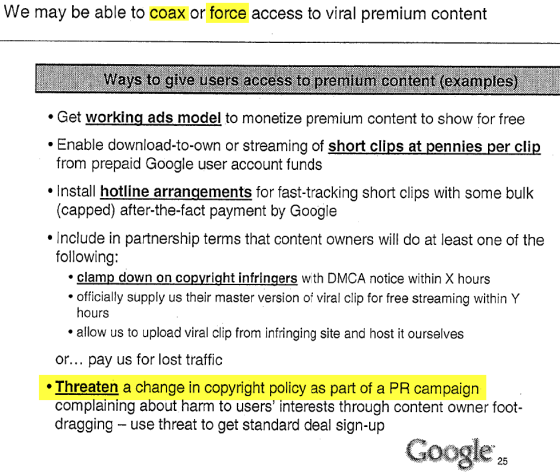
The above Facebook complaint sounds like the same complaints that came from the old media powers which Google used high power lawyers to steamroll over.

How can Facebook be surprised with Google entering a new vertical by not respecting the property rights of existing market participants? It has been Google's approach to virtually everything:

So far Google has only fell flat on their face once: when they challenged the pharmaceutical corporations:

Google Inc. is close to settling a U.S. criminal investigation into allegations it made hundreds of millions of dollars by accepting ads from online pharmacies that break U.S. laws, according to people familiar with the matter.

The pharma corporations are powerful & are in bed with the government. In spite of repeated felonious behavior in marketing their drugs for illegal off label use (which has literally murdered millions of people) these companies can have the government step in and protect their property rights, by having the government enforce unto others the same laws that these same pharma corps regularly break (literally killing millions of people).

Maybe Google is Philosophically Opposed to Property Rights?

Yes, but only when convenient!

Everyone *but* Google should be open.

While Google tramples on the property rights of everyone else, the first sniff of someone operating anything like they do drives Google into black-ops mode & they conduct a smear campaign. Google launched Buzz without warning, but when their feared Facebook was collecting more personal information than they could Google went into black ops PR mode warning against security issues in Facebook.

Remember that bogus "Bing is copying our results" stuff Google engineers did earlier this year? Google later rolled out their content farm update & many of the sites which were torched by Google are now getting more traffic from Bing. What does that tell us? If Bing was putting *any* significant weight at all on Google rankings & traffic then why didn't that carry any weight when Google torched a bunch of websites?

Here is the Google traffic profile for a site that was torched by Panda

And that same website's Bing traffic

Google traffic fell through the floor, while Bing traffic kept climbing. Some sites that were hit by Panda are getting more visits from Bing or Yahoo! Search than from Google.

Conclusion? Once again Google distorts media to promote itself & its business interests, while bogusly smearing competitors with fabricated trash.

Part of why Microsoft's search marketshare is less than Google's is that Microsoft is willing to block sleazy traffic partners, unlike Google. But Google's treatment of their partners is inconsistent. Using "inside voices" Googlers openly explain in plain English how they treat their partners: "we are using compatibility as a club to make them do things we want" - Google's Dan Morrill.

Big Companies Hate Honest Market Innovation

Large companies are largely counter to honest innovation in the marketplace. They are comfortable atop the perch and want to lock down innovation to maintain their current dominance.

Sure the big banks welcomed CDOs, MERS, etc. ... but those were welcomed precisely because they were part of an elaborate scheme of dishonesty and fraud. But the same society which brings us CDOs built on fraud (that ultimately cost you your job, your house, your retirement savings, the value of the currency, etc.) is also a society where dirty corporate whores push to force smaller market competitors to be entirely transparent.

This stuff is literally everywhere. Consider this: Major Record Labels Forced to Pay $45M USD for Pirating Music. Once again, property rights are only important when they are forcing their own rights, but they are willing to walk on the rights of others. Consider the actions of MarkMonitor, yet another seedy Google partner:

I have for years been telling you even if you have no interest in the new gTLD?s you had to pay close attention to the process as whatever rules come out of that process will be attempted to be applied to all existing TLD?s including .com, .net and .org.

This is especially troubling because as you know the new gTLD process has not even been approved yet since the .Net contract is up for renewal, trademark groups are going to push for this new system to take away domains, be imposed on .net

The very domain name of the front organization that is pushing to remove domain privacy is registered using a private registration. ipconstituency.org uses Domain Discreet!

Read this piece on Google & Skyhook and ask yourself if Google is actually open & is promoting or suppressing market innovation.

Small Businesses Typically Can't Act Sleazy

Try getting customer service from Google & you will quickly find yourself in a hall of mirrors. Compare that to the customer service you get from a small company. Sure some small companies may decide they have no interest in supporting freetards, but if you are actually a paying customer you will usually be treated well by small companies because word of mouth marketing is the most important lead channel for many small businesses.

When a consumer or small business owner gets caught (acting like a big business, and) doing something illegal they go to jail. When a big business repeatedly commits serious crimes the wost thing that could possibly happen is a shake up of management. A company has no soul. A corporation can't go to jail.

This is precisely why Google's corporate-first approach to relevancy is bad.

Soon after the Facebook/Google story broke a friend of mine told me they put ?facebook smear of google? in Google & they got:

  • Image result = Globe and Mail
  • Number one result = Huffington Post
  • Number two result = TechCrunch (top websites are both AOL properties)
  • Number three result = Get more results from the past 24 hours
  • Number four result = The Daily Beast ? better known as the site that broke the story.
  • All other results are a retelling and mashup of the original.

The big publishers complained that smaller sites were stealing their stories. Google made secret arrangements with the Online Publishers Association & now the big companies get to rank at the top of the search results for stories that they stole from smaller outlets.

While small players are desperately fighting against each other for scraps off the table, the pawns have been driven out of the search ecosystem.

All webmasters are equal but some webmasters brands are more equal than others

Society hierarchy has been restored.

Don't be evil, just be corporate.

Categories: 

Source: http://www.seobook.com/google-facebook

list building article marketing affiliate marketing clickbank experts copywriting experts

Wednesday, June 1, 2011

Facebook vs. Google: Battle of the Online Giants

Google vs. Facebook

Godzilla vs. Mothra, Freddy vs. Jason, Alien vs. Predator, and now this summer, coming to a theater near you: Facebook vs. Google.

It’s no secret that social is the new currency across the internet, but Facebook’s recent attack on Google shows just how precious and coveted such social data is.

Facebook Hires PR Firm to Bad-Mouth Google

Over the past few days, there has been a lot of speculation concerning what mysterious entity hired the private PR firm Burson-Marsteller to encourage mudslinging against Google by pitching anti-Google stories to newspapers. Dan Lyons at the Daily Beast reports that they discovered it was none other than Facebook – and they found out just by asking.

A Facebook spokesman admitted that the company hired Burson for two reasons:

First, because it believes Google is doing some things in social networking that raise privacy concerns; second, and perhaps more important, because Facebook resents Google’s attempts to use Facebook data in its own social-networking service.

It’s almost enough to make you laugh and write the whole thing off as a joke. Facebook, complaining about privacy concerns? Facebook? The same Facebook that is notorious for trying to trick users into signing away more and more of their private information? Facebook’s flagrant backhanded ways are truly astounding! As Andy Beal at Marketing Pilgrim notes,

Agreed, Facebook shouldn’t have started this campaign in the first place, but to go on record admitting to it? It’s not like Facebook came forward with a mea culpa. It didn’t apologize for such a bone-headed move. It practically bragged about it and then tried to justify its actions!

Even in trying to discover exactly what Facebook is moaning and groaning about, there seems to be quite a bit of confusion about how and where Google is using Facebook data. There’s the Google Social Search, the old, now extinct Google Social Circle (now named Social Connections), then there’s Google Social Circles which doesn’t officially exist yet. Yikes, it’s enough to give you Googly Eyes.

Playing By its Own Rules

In one pitch Burson sent out in hopes of getting writers to do some Google bashing, Burson claims that “Google will simply ‘scrape’ their information from dozens of sources and compile the data into one massive dossier aligned directly with user’s personally identifiable information.” Danny Sullivan at Search Engine Land notes that Facebook encourages said “scraping” through its recommendations to the Privacy settings. He calls attention to the fact that:

Facebook has encouraged its users to share information with 'everyone' and actively published that information out onto the open internet. But because Google doesn’t want to play by Facebook’s rules to harvest this publicly published information, Facebook seems to want to cry foul.

Personal Data: The New Gold Standard

Facebook knows all too well that personal data is the new marketing gold standard, and with information on over 500 million users, Facebook is rolling in data wealth. Although Facebook is the one opening up these mines, the company is clearly ready to use treacherous means to keep that gold in their own pockets.

In watching the drama unfold, USA Today asked 26 Gmail users about Social Circle, and found that:

Only two were vaguely aware of the service, while 14 said they would disable the service, if they could, citing privacy concerns.

Clearly this Facebook vs. Google mecha-battle is happening in a land that much of the population is unaware of. As Greg Sterling of Opus Research explained to USA Today, while the vast amount of Facebook users "freely provide information about themselves, it's far less clear that they understand how that information is being used by Facebook or third parties to profile them."

The battle has only just begun, and with Facebook clearly willing to use every dirty trick in the book, Google will have to come up with some clever schemes of its own to hold ground in the social realm.

This post originated on the WordStream Blog. WordStream provides keyword tools for pay-per click (PPC) and search engine optimization (SEO) aiding in everything from keyword discovery to keyword grouping and organization.

Source: http://www.wordstream.com/blog/ws/2011/05/13/google-vs-facebook

online marketing website optimization improve google rankings search engine search marketing

AdWords: Yet Another Problem With Google's Panda Update

Hit By Panda

In a recent comment someone shared the fate of Patrick Jordan, owner of justanotheripadblog.com.

Since the Panda update happened, some scraper websites (monetized by Google AdSense) have started outranking Patrick for his own content.

Panda = No AdWords Soup for You

Distraught with the decline in traffic, Patrick turned to AdWords to try to bridge the gap and drive some revenues.

Unfortunately, Google wouldn't let him do that either:

I asked on what grounds he had decided that my site does not produce original content. His answer was that he had typed a sentence into Google and found it contained at many sites around the web. Seriously, I made a lengthy strong case for my site's record of having 100% original content and he typed one sentence into a Google search.

I emailed back and asked him to be specific about his search. This was his reply:

"An example of a specific sentence that appears in multiple websites is "a superb app for iPad and iPhone that lets you quickly and easily transfer photos and videos between iOS devices and computers ? has been updated this week, to Version 2.3."

Google Rolls Out the Red Rug (for AdSense Scrapers)

Think about how perverse this is:

  • Google algorithmically penalizes your site
  • Google won't say why it is penalized, other than some abstract notion of "quality"
  • Google offers no timetable on when things can improve, but suggests you keep spending increasing sums of capital to increase "quality"
  • Google pays scraper sites to steal your content & wrap it in AdSense ads
  • Google ranks the stolen content above your site (so the content has plenty of "quality" but it is just not "quality" on your website)
  • Google ignores your spam reports & DMCA notifications about how they are paying people to steal your content
  • Google tells you that you can't even buy AdWords ads, because you are now duplicate content for your own content!

Contributory Copyright Infringement

So now we have Google telling advertisers "I won't even take your money" precisely because Google is paying people to steal their content. Small publishers likely don't have the capital needed to sue Google, but clearly what Google is doing here *is* flagrant, systematic, abusive, and illegal (contributory copyright infringement).

One of Google's larger enemies may want to fund some sort of class-action lawsuit. Google deserves far more of a black eye than they have got in the press from the embarrassment that is the Panda update.

Um, Could You Please Help Me Out a Bit Here Google?

Patrick Jordan begged Google for help in March. In response they sent him this:

Yet Another Webmaster Loses Faith (& Trust) in Google

Since Google has ignored him (for months), Patrick felt he had to rebrand & redirect his old website to a new iPad website. Google made (a rather long and egregious series of) mistakes. And he had to pay the price for it, because Google is a monopoly that doesn't give a crap about how destructive their business is on the ecosystem, so long as it increases their profits.

Again I ask, how long does Google leave this mess in place before publishers broadly take a more adversarial approach to publishing?

Now that Google is aware that the panda fallout is costing THEM money, it will likely get cleared up quickly. I suspect to see an update within the next couple weeks at most. And it would happen even quicker if the press actually did its job. ;)

Update: Matt Cutts stated that the site wasn't hit by Panda here, so that wasn't what caused this. However that still means that Google has to work on better highlighting original content sources over the scrapers, stop funding the scrapers via AdSense, and improve the internal policies which state that you can't buy ads if a scraper outranks you for your own content!

Categories: 

Source: http://www.seobook.com/no-adwords-soup

social media social networking social media marketing website development web hosting

Introducing the +1 button

Source: http://feedproxy.google.com/~r/blogspot/amDG/~3/H1271Uu4jug/introducing-1-button.html

internet business link popularity link exchange pay per click ppc experts

Sales Marketing Manager / Everyday Health / New York, NY

Everyday Health/New York, NY

Everyday Health, founded by Ben Wolin and Mike Keriakos in 2002, is a leading provider of online health solutions. We provide our consumers, professionals, advertisers and partners with content and advertising-based services across a broad portfolio of over 25 websites that span the health spectrum�??from lifestyle offerings in pregnancy, diet and fitness to in-depth medical content for condition prevention and management.

The Everyday Health portfolio includes well-recognized and trusted consumer health brands, including www.EverydayHealth.com; www.SparkPeople.com; www.WhatToExpect.com, from the best-selling What to Expect When You're Expecting series of books; www.SouthBeachDiet.com, from one of the best-selling diet books of all time; and www.JillianMichaels.com, from Jillian Michaels, host of the hit NBC television show, The Biggest Loser. The portfolio also includes www.MedPageToday.com, a news organization serving healthcare professionals.

Everyday Health is committed to providing the expert guidance and daily tools consumers need to make the best health choices, actively manage their conditions and live healthier lives every day.

Everyday Health is seeking a strategic and experienced Sales Marketing Manager to join our newly-created Professional division. The Sales Marketing Manager will work closely with the Sales Marketing Director and Professional team to develop value-adding custom programs and solutions for our advertising clients across our healthcare professional websites and digital properties, including www.MedPageToday.com. S/he will be responsible for idea generation, strategy, and the development of innovative sales collateral, presentations, and proposals in response to RFPs from blue chip pharma and healthcare advertisers. The position will play a critical role in growing, developing, and maximizing revenue for the Professional business.

Job Requirements:

�?�3+ years experience in sales marketing and development, with proven success in creating compelling and revenue-generating presentations, proposals, and sales collateral
�?�Superior writing and proofreading skills
�?�Strong interpersonal & presentation skills
�?�An entrepreneurial spirit and ability to grow a newly-created division
�?�Ability to influence others through well articulated and innovative ideas
�?�Ability to communicate effectively at all levels of the organization
�?�Adaptable person who can deal with rapidly changing requirements of an organization
�?�Ability to prioritize and multi-task while meeting tight deadlines
�?�Accountability - acceptance of responsibility and willingness to commit to and deliver specific, measurable work


Apply To Job

Source: http://jobs.searchenginejournal.com/job/sales-marketing-manager-new-york-ny-everyday-health-8687361475/?d=1&source=rss_page

search engine marketing sem experts search engine optimization internet marketing online marketing

Giving Your Links a Boost with Tiered Link Building


The following link building tip may or may not sit well with all SEOs, and when deciding on a strategy that will suit your business, it's important to weight all the pros and cons before making a choice. Now, with that said, let's talk a little about tiered link building.

Tiered link building allows you to drive some extra juice to your quality links and keep the more aggressive link building tactics aimed at buffers in between the more questionable links and your website. The below is a very quick overview of what this may look like.

tiered link building

Getting Quality Links

Quality links in the above diagram are those you are proud of. They are the kids in the frame on your living room wall, with happy faces having just graduated from college. There are a number of ways to get quality links:

1) Create Great Content: You can create market-relevant content for a target group of users, and even with limited time you can still attract links with content.

2) Guest Blog Posts: This is perhaps one of the easiest way of acquiring quality links. It can be difficult to scale, but one suggestion would be to look on sites like MyBlogGuest for bloggers who are willing to a) look for guest blogging opportunities and b) write the actual content. You can arm them with a list of queries relevant to find these opportunities, for example:

  • “Submit a guest post” / “Submit post” / “Submit blog post”
  • “Add blog post”
  • “Submit an article”
  • “Suggest a guest post”
  • “Send a guest post”
  • “Write for us”
  • “Become an author”
  • “Guest bloggers wanted”
  • “Contribute to our site”
  • “Become a contributor”
  • “Become guest writer”
  • “(Write for our) guest column”

There are dozens more commands that can be used for this. If you are lucky enough to have a tool like Ontolo, it can do all the work for you.

3) Articles / Web2.0 Sites: No doubt the Google farmer/panda update has caused big issues for article and web 2.0 sites. But if you create quality content on sites like Squidoo, Tumblr, and EzineArticles, it can still lead to quality links that can act as buffers. The important words here are “quality content.”

4) Satellite Sites: Buying aged domains and rebuilding them with content relevant to your market is definitely something that can help you rank for competitive keywords. Just ensure you choose a domain that has some relevance to the space you are in (by checking on Archive.org to see what content the site used to have).

Boosting Your Links

There are a number of ways to build link layers to boost your quality links:

1) Social Forum Profiles: Obviously something that a lot of people will not agree with, but creating hundreds or thousands of social profile links can help boost your quality links. This can be done extremely cheaply; just look over on the WarriorForum and there are dozens of people offering these services.

2) Article Spinning: Not something that fared too well during the recent Google update, but sites like ArticleRanks allow you to spin an article and distribute across a wide range of article sites and blogs. All of these are extremely low-value, but can create thousands of links.

3) Blog Networks: This is something Google must despise, but networks like LinkVana, SEONitro and BuildMyRank allow you to distribute posts across their own private network.

4) Auto Social Factors: There are a lot of services like Synnd that will auto-tweet, bookmark and like your content. Again, this can be a means of getting a little extra juice to your quality links (although, I would see this as something that may be at layer 3 of your tiered pyramid).

The above is a quick overview of how tiered link building can be used to boost your quality links and ensure you are getting the max juice from them.

This is a guest post by Kieran Flanagan, a European SEO manager with a large international company. Kieran offers SEO services at Searchbrat.com. He also builds affiliate sites in competitive markets.


This post originated on the WordStream Blog. WordStream provides keyword tools for pay-per click (PPC) and search engine optimization (SEO) aiding in everything from keyword discovery to keyword grouping and organization.

Source: http://www.wordstream.com/blog/ws/2011/04/11/tiered-link-building

affiliate marketing clickbank experts copywriting experts internet business link popularity